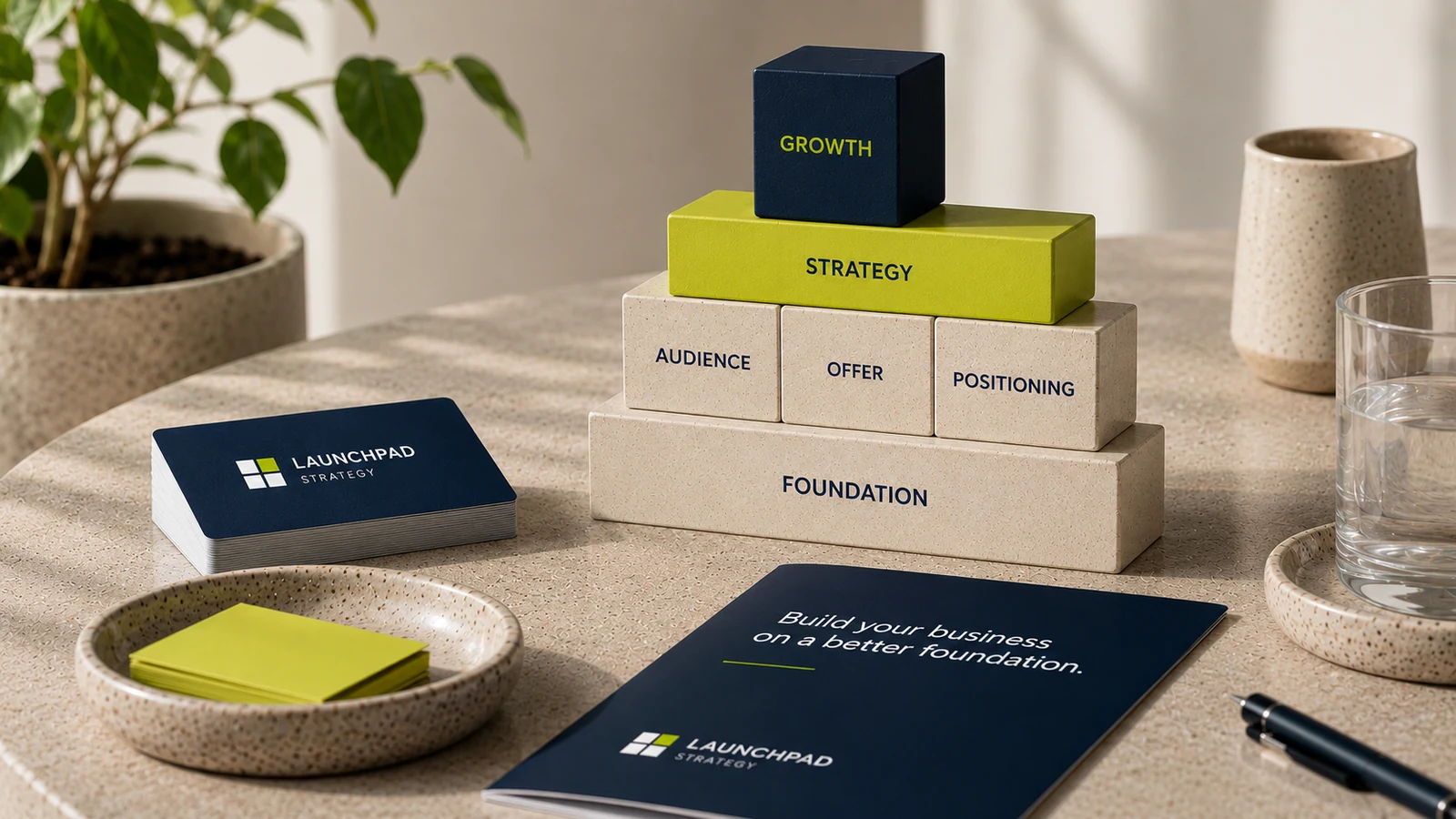
Build your business on a better foundation


Aug 18, 2026

Business Foundations

5 Minutes
The visible parts of a business are usually what people notice first. But the decisions underneath them are what shape how well the business works and how confidently it can grow.
When people start a business, the visible pieces are often the most tempting to work on first: the name, logo, website, product, social pages and first marketing campaign. But if the audience, offer, pricing or business model are still shifting, those visible pieces have to keep shifting too.
The foundation is the thinking underneath the business: who it’s for, what problem matters enough to solve, why someone would choose the offer, how the business will make money and what needs to happen first. The clearer those decisions are, the easier it becomes to build the website, pricing, messaging and customer journey around them.
What a better foundation gives you
A strong foundation won’t remove uncertainty. Every business changes as the founder learns more about the market, customers and delivery. What it does give you is a clearer basis for making decisions when something changes.
You understand what the business is trying to become, who it is designed to help and where the boundaries sit. That makes it easier to recognise which opportunities fit and which ones are more likely to pull the business off course.
What sits underneath a strong business?
A clear audience and a problem that matters
A broad audience makes the offer, messaging and marketing harder to shape. A stronger starting point is a clear picture of who you want to help, the situation they’re in and the problem they’re already motivated to solve.
Evidence that the opportunity is real
Positive feedback can be useful, but you also need to understand what people are already doing about the problem, what alternatives they use and what evidence suggests they may spend time, attention or money on a different solution. Validation helps you understand what you know, what you’re still assuming and what needs further testing.
An offer people can understand and choose
A good idea still needs to become a clear offer with defined boundaries, sensible pricing and an outcome the customer can understand. When the offer is clear, the website, sales conversation, proposal and delivery process can all tell the same story.
A commercial model that works
You need a realistic view of what you’ll charge, how often people may buy, what it costs to deliver and what margin remains. The numbers will change, but they should be grounded enough to show whether the idea can support the time, effort and investment required.
A practical plan and foundations that can grow
A plan helps you decide what to build now, what can wait and which risks deserve attention first. You don’t need complex systems from day one, but it’s worth thinking early about how the business will work if demand grows, what information needs to be captured, and which decisions would be difficult or expensive to undo later.
Why early gaps become harder later
Weak foundations don’t always create an immediate problem. A business can move quickly for a while because decisions are being made on the run and the founder is close to everything.
The pressure often appears later, when there are more customers, more people and less time to stop. Pricing becomes inconsistent, delivery relies too heavily on the founder, the website no longer reflects the business, and systems are held together by workarounds. Usually, the business has simply grown faster than the thinking and structure underneath it.
Where should you begin?
You don't need to solve everything at once, start by asking:
What do I understand clearly and confidently?
What am I still assuming because I haven't tested or researched it?
Which decision would be expensive or disruptive to undo later?
Those answers will usually show you where the foundation work needs to begin. A strong business isn’t built by having every answer before you start, it’s built by asking the important questions early enough to make clearer, more commercially grounded decisions as you move forward.
Download the free checklist